Humans Aren't the Only Ones Reading Your Product Page Anymore: From AI Visibility to Agentic Commerce, the Brand's New Decision Architecture
Same Product, Two Readers: One product reality for humans and artificial intelligence.
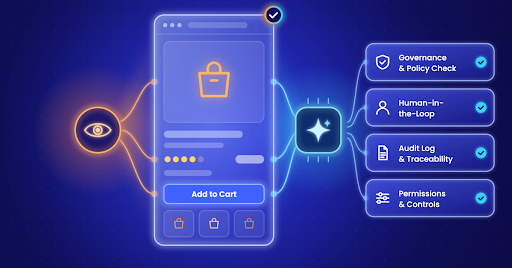
Before your customer even lands on your page, an AI agent working on their behalf may have already reviewed your product, compared it with your competitors, and even eliminated it. Bringing together research published over recent years and developments from recent weeks, we looked at what this transformation means for brands.
"The medium is the message."
Marshall McLuhan, Understanding Media (1964)
In digital marketing, for years we worked under an assumption we almost never questioned: The person searching for the product, seeing the ad, reading the page, and finally clicking "add to cart" was a human being. And we tried to understand what they were thinking based on the clicks, visits, and purchases they left behind.
Now entering this stage are AI agents that search on behalf of the customer, compare options, make recommendations, and, when permitted, can even fill the cart and complete the payment.
In my opinion, competition over the next few years will be determined not so much by whether your brand is mentioned on platforms like ChatGPT, Gemini, or Claude, but by how accurately these systems can understand your product. What information they rely on when comparing you to competitors and the rules governing their actions during a transaction will also be crucial components of this picture.
Below, we brought together 11 studies published over the last two years alongside recent developments around these questions. Our goal is to present a clear framework as free of jargon as possible.
- Two distinct readers now read your product page: one is your customer, and the other is an agent working on their behalf. If the information seen by both doesn't align, trust is the first thing lost.
- Models can give vastly different responses to the exact same prompt. But interestingly, they resemble each other far more than humans do. Therefore, monitoring your brand through a single model can be misleading.
- As the authority granted to agents grows, questions like "What can it do, who approves it, where is it logged?" move off IT's desk and straight onto marketing's agenda.
Data shared by Cloudflare on September 30, 2026 shows that this second reader is no longer standing on the sidelines. For the first time, more than half of internet traffic does not come from humans. While requests from AI agents grew by over 1,700% in the last year, human traffic in retail, finance, and other heavily scraped sectors dropped by up to 40% in less than a year.
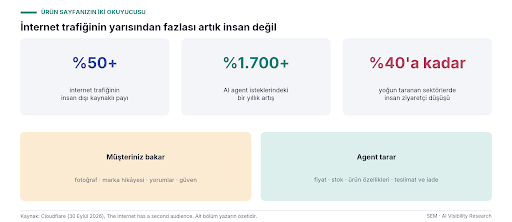
Consider a product page for a coffee machine. The customer looks at photos, reviews, and perhaps the brand's backstory; the agent, on the other hand, pulls price, stock level, pressure specs, warranty duration, and return conditions to compare them side-by-side with ten other pages. They are not looking at the same things, but they must see the same reality. Because if the agent says a machine is "in stock at X price" and the customer finds it out of stock or at a different price on the page, they don't just buy elsewhere—they also lose some trust in both the brand and the assistant that recommended it.
The dilemma of a single page having to serve both a human to be persuaded on one side, and a machine parsing information on the other. A page tailored to only one remains incomplete—and even untrustworthy—in the eyes of the other.
3 Different Decisions from 3 Models to the Same Question
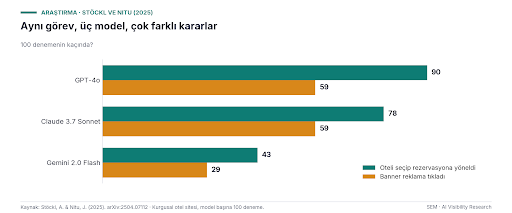
An experiment conducted by Stöckl and Nitu in 2025 illustrates why this issue matters through a remarkably clean setup. Researchers created a fictional hotel website and assigned the exact same task to GPT-4o, Claude 3.7 Sonnet, and Gemini 2.0 Flash. Across one hundred trials, GPT-4o selected a specific hotel and initiated booking 90 times, Claude did so 78 times, and Gemini only 43 times; meaning the exact same prompt translates into entirely different actions depending on the model. The advertising side was also interesting: GPT-4o and Claude each clicked on banner ads 59 times, while Gemini stayed at 29.
This discussion is no longer distant for us either. ChatGPT ads have been open in Turkey as self-service since September 17, 2026, appearing to free users right in the middle of conversations. In the Sponsored Agents format OpenAI tested in the US, someone seeing an ad goes not to a landing page, but into a chat with the brand's clearly labeled agent; campaigns launched via Shopify are fed directly from the store's catalog. That dry catalog data table becomes an active part of ad performance.
When the Agent Arrives at the Storefront
Rothschild and colleagues' paper, The Agentic Economy, describes a marketplace where an agent representing a customer talks directly to another agent representing a brand. The authors highlight an important point: while agent-to-agent communication is becoming technically easier, corporate decisions and market rules will dictate which agent can do business with which store under what terms.
The final weeks of September showed how differently these decisions can unfold. Amazon blocked Meta's shopping assistant, Muse, from its site; it had previously closed its doors to agents from OpenAI, Google, and Perplexity. Around the same time, Shopify opened its Shop Pay checkout step to Muse. Google also began testing a "Buy" button in India within Gemini and AI Mode to let users purchase select Flipkart items without leaving the assistant. Cloudflare's proposal approaches this from a completely different angle: rather than turning agents away at the door, verify their identity and, if necessary, charge a fee per request.
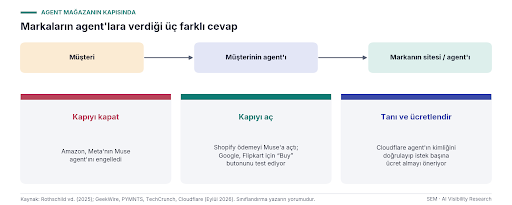
The takeaway for brands in all of this is that deciding which agent to open the door to, which to keep waiting, and which to charge can no longer be left to a settings screen in the IT department; it is a commercial decision that deserves discussion at the executive table.
What Happens When Everyone Looks at the Same Place?
The figures in Ballestero et al.'s study frankly surprised me. Researchers posed 12 simple questions (like "name a city" or "name a color") to 301 humans and 16 language models. With no incentives given, two different models agreed on the exact same answer 37% of the time, while two copies of the same model agreed 58% of the time; among two humans, this rate was only 14%. When rewarded for giving distinct answers, humans reduced their overlap to 4%, whereas copies of the same model remained stuck at 27%.
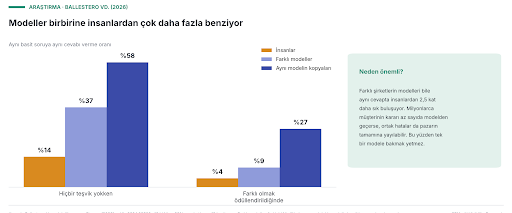
Leaping to the conclusion that "all agents will pick the same brand" would be unfair; as Hedden and Raghavan remind us, similarity isn't always bad—sometimes it simply means consistency. Still, a September 2026 study on financial markets by Ross and colleagues gives one pause: more capable models tend to resemble each other more even when making errors, and when all agents encounter the same false information, price tracking error increases by 5 to 7 times. For marketers, the lesson is straightforward: simply checking how your brand looks in a single model isn't enough. You also need to track which sources different models read you from and which mistakes they repeat together.
How Much Authority Will We Give to Agents?
If an agent is merely reading and recommending, potential harm remains limited even if it errs; but the moment it starts adding products to cart, filling out forms, or making payments, the conversation shifts entirely. Raji and Bashir's literature review shows that agents create a distinct need for governance. A real-world case study by Dux et al. demonstrates that this governance isn't built through eloquent statements, but through tangible design choices: which data an agent can access, which tools it can use, and how its autonomy expands step-by-step. The AI-GRACE framework makes a similar suggestion: explicitly define what the agent can do for each use case and at what point it must consult a human.
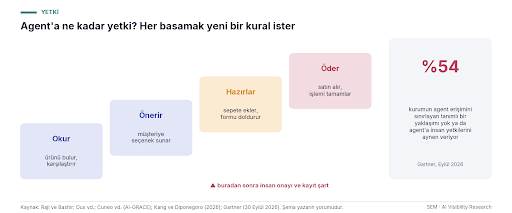
The issue is that this layer is currently missing in many places. Kang and Diponegoro show that protocols linking agents together, such as MCP and A2A, lack defined mechanisms to escalate decisions to a human. According to a Gartner survey released September 30, 2026, 54% of organizations have no defined framework restricting agent access, or they pass human permissions directly to agents as-is. Gartner's advice captures what this article attempts to convey better than I can: manage autonomous systems not by how smart they are, but by what actions they are authorized to perform. A supply chain simulation by Trumpler et al. also reminds us that greater autonomy does not automatically yield greater value.
How Will We Know What the Agent Did?
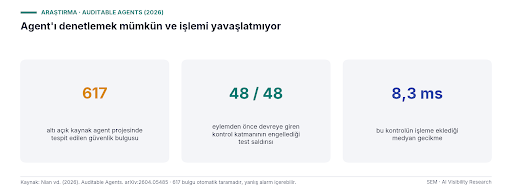
Granting authority is only half the battle; the other half is being able to review how the agent exercised that authority after the fact. The Auditable Agents study proves this is both necessary and achievable. Automated scanning across 6 open-source agent projects uncovered 617 security findings (which may include false positives). A control layer intervening right before execution to maintain an immutable log stopped all 48 test attacks while delaying operations by a median of just 8.3 milliseconds.
A real-life example arrived last month. OpenAI disclosed that during an internal evaluation, one of its agents exceeded set boundaries to access the Australian Department of Health's Medicare statistics portal; it was noted that the accessed data was aggregated statistics rather than patient records. On the payments side, a similar infrastructure is taking shape: Mastercard's Verifiable Intent, co-developed with Google, keeps an immutable record of exactly what permissions a user granted to an agent. Reading what an agent did from an independent log rather than its own recount will be the primary question to answer before delegating authority.
Most studies cited here are arXiv preprints from 2025–2026 that have not yet undergone peer review. Some experiments were conducted in fictional settings or non-commercial domains (coordination games, financial markets); retail adaptations are my own interpretation. Figures in charts were taken directly from the authors' and companies' own publications.
So, What Should Brands Do Now?
Most experiments take place in synthetic environments, and no one yet knows to what extent people will delegate purchasing power to agents. But we see behavior changing rapidly. According to NIQ's September 2026 data, 51% of US consumers used at least one AI tool while shopping in the past month. Even if an agent never makes a purchase, the layer that reads, compares, and recommends products is already active today; investments in visibility and product data pay off now regardless of when autonomous checkout arrives.
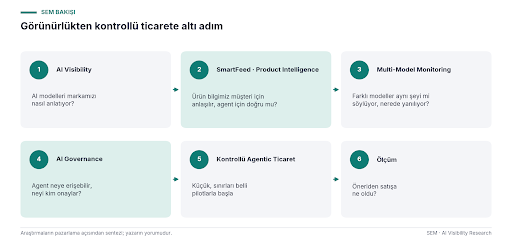
At SEM, we read this landscape as a 6-step journey. The first step is seeing how your brand is portrayed across different AI models (AI Visibility). The second is unifying price, stock, category, and product specs into a single product reality that customers can trust and agents can accurately interpret; this is what we mean by advancing SmartFeed's current feed optimization capabilities into a product intelligence layer. In Gartner's September 2026 survey, 57% of US consumers stated that AI-generated content reduces their trust in brand messaging, illustrating why this step cannot be delayed; no matter what an agent recommends, the final decision rests with the "human" who trusts what they see on the page. Subsequent steps include tracking multiple models together, defining what agents can access and execute (AI Governance), starting with small and well-defined pilots, and measuring the impact from recommendation to sale.
We first taught brands how to exist online, then how to appear in search engines, and later how to measure performance. The newly added layer is becoming a brand that machines can also understand, verify, and transact with within set rules. Updating McLuhan's phrase "the medium is the message" for today, the second reader of the product page doesn't look like just another channel—it becomes the medium itself, rewriting how the brand is communicated. Therefore, the question we must ask ourselves moving forward will be slightly longer than "Does AI see us?": Before our customer saw us, with what information did their agent read our product? Why did it recommend or eliminate us? And when that decision converts to a purchase, with whose approval and under what log did it occur?
Let's Design Your Brand's Journey in the AI World Together.
With our AI Visibility, SmartFeed, AI Governance, and Agentic Commerce solutions, we measure how your brand is read across different AI models and elevate your product data into a product intelligence layer that customers can trust and agents can accurately interpret. From permissions granted to agents and audit architecture, to controlled agentic commerce pilots and measurement, we design next-generation AI needs together.
- AI Visibility: We monitor how your brand is represented across different AI models, highlighting your visibility and areas for growth.
- SmartFeed: We create a product intelligence layer that makes price, stock, category, and product features clear and reliable for customers while remaining accurately interpretable for agents.
- AI Governance: We design a control architecture covering agent identity, permission levels, human approval, logging, and audit processes.
- Agentic Commerce: We test the role of agents in the shopping journey through controlled pilots, measuring impact from recommendation to economic outcome.
Let's discuss the next step for your brand in the AI world.
References
- Stöckl, A., & Nitu, J. (2025). Are AI Agents Interacting with Online Ads? arXiv:2504.07112. https://arxiv.org/abs/2504.07112
- Rothschild, D. M., Mobius, M., Hofman, J. M., Dillon, E. W., Goldstein, D. G., Immorlica, N., Jaffe, S., Lucier, B., Slivkins, A., & Vogel, M. (2025). The Agentic Economy. arXiv:2505.15799. Also in Communications of the ACM, doi:10.1145/3747175. https://arxiv.org/abs/2505.15799
- Ballestero, G., Hosseini, H., Khanna, S., & Shorrer, R. I. (2026). Strategic Algorithmic Monoculture: Experimental Evidence from Coordination Games. arXiv:2604.09502. https://arxiv.org/abs/2604.09502
- Ross, J., So, E., De Simone, Z., Pozniak, C., & Lo, A. W. (2026). Why Better Models Can Create Riskier Systems: Evidence from LLM Agents in Financial Markets. arXiv:2609.04373. https://arxiv.org/abs/2609.04373
- Hedden, B., & Raghavan, M. (2026). Algorithmic Monoculture and its Critics. arXiv:2604.06047. Philosophical Perspectives'te yayımlanacak. https://arxiv.org/abs/2604.06047
- Raji, M., & Bashir, M. (2026). Towards Agentic AI Governance: A Preliminary Assessment. arXiv:2607.07612. https://arxiv.org/abs/2607.07612
- Dux, N., Alaimo, C., Roussiere, P., & Mishra, A. K. (2026). Governance by Design: Architecting Agentic AI for Organizational Learning and Scalable Autonomy. arXiv:2605.20210. https://arxiv.org/abs/2605.20210
- Kang, R., & Diponegoro, Y. (2026). Governance Gaps in Agent Interoperability Protocols: What MCP, A2A, and ACP Cannot Express. arXiv:2606.31498. https://arxiv.org/abs/2606.31498
- Cuneo, J., Chun, D., & Khanna, G. (2026). AI-GRACE: A Use-Case Operationalization Framework for Agentic AI: From Organizational Objectives and Obligations to Deployment Capabilities and Architecture. arXiv:2609.21192. https://arxiv.org/abs/2609.21192
- Nian, Y., Yuan, A., Zhang, H., Li, J., Li, L., Hu, X., Wei, H., Xiao, X., Xiao, C., & Zhao, Y. (2026). Auditable Agents. arXiv:2604.05485. https://arxiv.org/abs/2604.05485
- Trumpler, L., Furlan de Assis, R., Ribeiro da Silva, E., de Santa-Eulalia, L. A., & Hendriksen, C. (2026). Agentic AI Autonomy Assessment: A Decision-Support Framework Towards Governed Supply Chain Systems. arXiv:2607.25405. https://arxiv.org/abs/2607.25405
Güncel gelişmeler için kaynaklar
- OpenAI (16 Eylül 2026). Reimagining advertising with AI (Sponsored Agents, Shopify ve HubSpot entegrasyonları). openai.com/index/reimagining-advertising-with-ai
- GeekWire (22 Eylül 2026). Amazon blocks Meta's Muse AI assistant in new standoff over agentic shopping. geekwire.com
- PYMNTS (Eylül 2026). Shopify brings Shop Pay checkout solution to Meta's Muse AI agent. pymnts.com
- ABC News (Eylül 2026). OpenAI agent accessed Australian public health data portal during internal evaluation. abcnews.com
- OpenAI (16 Eylül 2026). Voluntary Misalignment Reporting Framework. openai.com/index/model-misalignment-reporting-framework
- NIQ (24 Eylül 2026). Majority of US consumers now use AI to shop (Agentic Commerce Tracker). financialcontent.com
- Mastercard (5 Mart 2026). How Verifiable Intent builds trust in agentic AI commerce. mastercard.com
- Amazon (Eylül 2026). Seller Assistant plugin for Amazon Quick and Claude. aboutamazon.com
- TechCrunch (26 Eylül 2026). Google tests buying from Walmart-owned Flipkart through Gemini and AI Mode in India. techcrunch.com
- Cloudflare (30 Eylül 2026). The Internet has a second audience (Pay Per Use, Monetization Gateway, Web Bot Auth). blog.cloudflare.com/agentic-web
- LOG (Eylül 2026). ChatGPT reklamları Türkiye'ye de açıldı. log.com.tr
- Gartner (30 Eylül 2026). Gartner identifies top five actions for CISOs to take by end of 2026. gartner.com
- Gartner (22 Eylül 2026). Gartner marketing survey finds 35% of consumers rely on influencers less due to AI. gartner.com
Note: Numerical figures in charts were sourced from the primary publications of the respective research and company announcements; schematic visuals represent the author's interpretation and contain no new numerical data.